
The ABCDE Rule for Identifying Potentially Dangerous Moles
- posted: Feb. 07, 2025
- Skin Care
The average person has between 50 and 100 moles. When somebody with fair skin has over 50 moles, they’re more at risk for melanoma. The number, however, isn’t a definite indication. Dr. Michael Masters of Blue Ridge Dermatology uses the ABCDE rule to identify potentially dangerous moles. His practice serves Clyde, NC, and the nearby region.
Here’s what you need to know about the ABCDE rule.
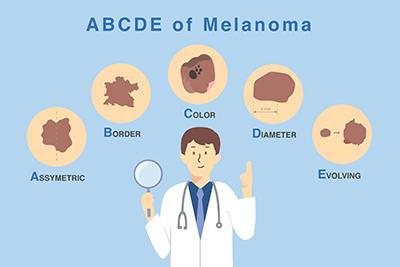
Know Your ABCDEs
- A Is for Asymmetry
Typically, a mole has symmetry, meaning both sides are the same. Common moles have genetic factors limiting their growth potential, making them round or ovular.
If you notice a mole that doesn’t have symmetry, it could be a cause for concern. Cancerous cells grow erratically and usually don’t have a specific growth pattern. They also aren’t in a restrictive environment. - B Is for Border
When you look at a common mole, you can see its border; it’s well-defined.
However, because cancer grows irregularly, a dangerous mole often has borders that are difficult to distinguish. - C Is for Color
A standard mole is usually one of the following colors:- Light or dark brown
- Black
- Flesh-colored
- Pink
A concerning mole can be black, but it may also be blue, red, or white. Sometimes, a cancerous mole is multiple shades, while a benign mole is usually one solid color.
- D Is for Diameter
Ideally, you want to catch a malignant mole in its earliest stage when it’s small and easy to remove. With that said, a mole with a large diameter that’s the size of a pencil eraser or bigger is a cause to schedule a visit with a dermatologist in Clyde, NC, to treat potentially dangerous moles.
As previously noted, a standard mole has restricted growth. - E Is for Evolving
By the time you reach your 30s and 40s, you typically have all the moles you’ll have in your life. Sometimes, once you’re a little older, the moles will change slightly in appearance or will lessen in color.
That said, moles shouldn’t undergo drastic changes. If you notice a mole becoming larger, changing color, or losing its defined border, it’s best to get it checked out by a professional.
Visiting Us
Get screened whenever you have any of the issues above with a mole or are concerned about a mole or multiple moles. We can examine all moles, identify abnormal ones, and provide testing to determine if they’re cancerous.
Dr. Masters of Blue Ridge Dermatology, serving Clyde, NC, and the general vicinity, can evaluate any moles for cancer. Still, it’s important to know your mole ABCDEs when necessary—call (828) 456-7343 for an appointment today.